Search results for: “christmas”

  • The Nature and Purpose of Christmas

    Christmas: The celebration of the birth of Jesus

    Christmas is celebrated across the world, and not just by Christians. Unbelievers also celebrate Christmas, often forgetting the message at the heart of the festival: the birth of Jesus!  This resource explains the key features of Christmas for the Christian community across the world.
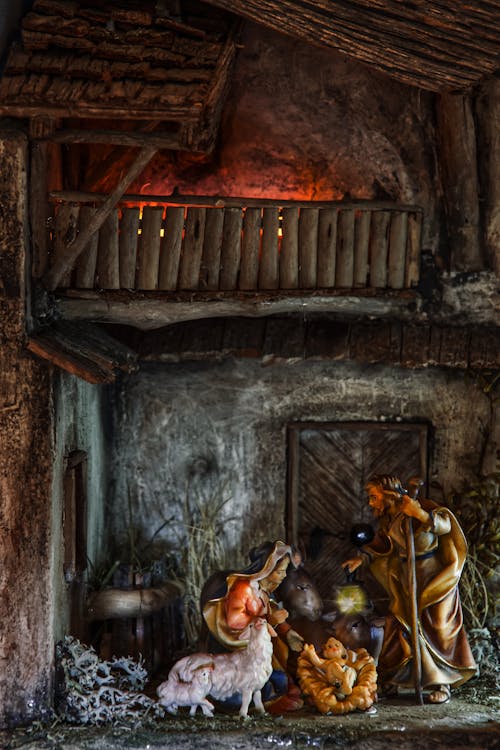
    Figurines Of The Nativity of Jesus

    THE BIRTH OF JESUS

    At Christmas, Christians celebrate the birth of Jesus, his incarnation: The Son of God who came to Earth in human form. This event is remembered in the Nativity Story, which is found in the four Gospels:

    ‘Joseph went from the town of Nazareth in Galilee to the town of Bethlehem in Judea, the birthplace of King David. Joseph went there because he was a descendant of David. He went to register with Mary, who was promised in marriage to him. She was pregnant, and while they were in Bethlehem, the time came for her to have her baby. She gave birth to her first son, wrapped him in cloths and laid him in a manger—there was no room for them to stay in the inn.’ Acts 2:4-7

    Christians believe Jesus was the Messiah, the one prophesied about in the Old Testament, who would be born to suffer for our sins in order to provide salvation for everyone:

    All of us were like sheep that were lost, each of us going his own way.But the Lord made the punishment fall on him, the punishment all of us deserved. He was treated harshly, but endured it humbly; he never said a word. Like a lamb about to be slaughtered, like a sheep about to be sheared, he never said a word. He was arrested and sentenced and led off to die, and no one cared about his fate. He was put to death for the sins of our people.He was placed in a grave with those who are evil, he was buried with the rich, even though he had never committed a crime or ever told a lie.’ Isaiah 53:6-9

    These words were written hundreds of years before Jesus was born!
    ADVENT

    The term ‘advent’ means ‘coming.’ It is a time of anticipation for Christians as they prepare to celebrate his birth during the run-up to Christmas, They light a candle on each of the four Sundays to signify Jesus, ‘Light of the World,’ coming to Earth.

    These candles each have a special meaning. You can find out more about what they mean here.


    TRADITIONS

    Like unbelievers, Christians have lots of traditions, such as putting up a Christmas tree, giving presents and sending cards to people at Christmas. Often these reflect their beliefs about Jesus.

    They will attend special church services, such as Midnight Mass on Christmas Eve, or Carol Services, where they watch nativity plays and sing Christmas carols. On Christmas day, families meet to spend time with each other, often attending a special service at church.

    Some Christians devote Christmas Day to charity work, helping in the community, expressing the real meaning of community.

     

  • Christmas: Why is it so Important to Christians?

    Christmas is probably the most popular of all Christian festivals.
    From the beginning of September shops and restaurants are getting ready for the ‘Christmas rush. Most schools will put on Christmas plays, in towns Christmas lights decorate the streets and Christmas trees can be seen everywhere.

    But for Christians, the importance of Christmas is not found in the shopping or the decorations – it is not even in the presents. Watch this short film to find out what makes it so special.

  • Christmas: Advent

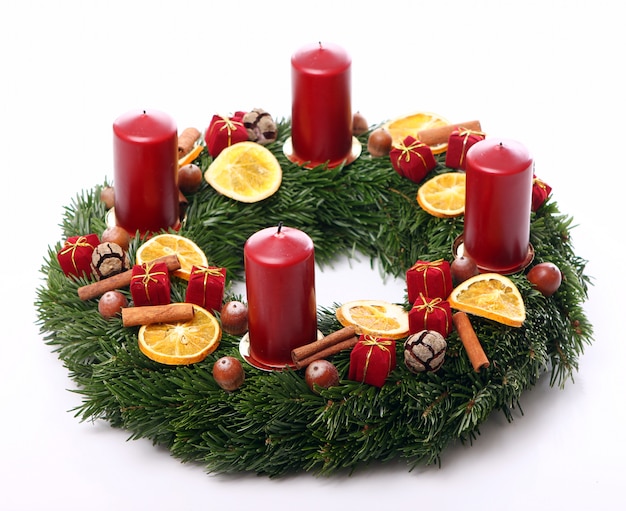
    Christmas wreath Free Photo

    The Christmas season begins four Sundays before Christmas Day with Advent. Advent means ‘coming’. Christians prepare to celebrate Jesus’ birth as a baby in the weeks that lead up to Christmas. They also remember that he will return as king and judge.

    Many Advent customs involve counting the days down until Christmas begins. There are many traditions surrounding the Advent Wreath. The wreath is usually a circular garland made up of evergreen branches. The garland is a symbol of the eternal nature of God – without beginning or end. On the wreath, there are four candles with a fifth one in the centre.

    The four candles can be blue or red, with the centre one being white or gold. In other traditions, there are three purple candles and one pink with the centre candle remaining white. The first candle is lit on Advent Sunday and then a new one is lit every Sunday leading up to Christmas. The centre candle is lit on Christmas day and is a symbol of Jesus – the Light of the World.

    One tradition surrounding the meaning of the candles claims that the first purple candle represents God’s people. This is the candle of hope. The second candle reminds people of the Old Testament prophets who foretold the birth of the Messiah. This is the candle of peace. The third candle is a symbol of John the Baptist and is known as the candle of love. The fourth candle reminds us of Mary the mother of Jesus and that candle represents joy. Each of the four candles represents people who prepared for the coming of Jesus and therefore the lighting of the candles helps Christians to prepare themselves for the Christmas festival. It is also a time to prepare and look forward to the time when Jesus will one day return.


  • Christmas: Quiz


    Think you know the Christmas story? Let’s see how well you do with the Christmas Quiz. Click on the panel to the right to begin…

  • Christmas Traditions

    Read through this timeline to find the reasons we do the things we do at Christmas…

  • Christmas: Why trees?

    The practice of decorating trees has been found in many ancient cultures. Often, trees were brought indoors and decorated to ensure a good crop for the coming year. The tradition of the modern Christmas tree was likely started in the 8th century with St. Boniface, a Christian monk who was working and living amongst the Germanic tribes.

    The people there used oak trees as part of their ancient religious worship. The oak trees would be decorated for the winter solstice. The story is told that St. Boniface cut down an enormous oak tree that was central to the worship of a particular tribe in defiance of this faith. To the surprise of everyone, a fir tree grew in its place.

    The fir tree was offered as a symbol of Christianity, which the newly converted Germans began decorating for Christmas.

    Prince Albert, who was German, introduced the Christmas tree to England after his marriage to Queen Victoria in 1840.

    Did you know? For many years small candles were used to decorate Christmas trees. In 1882 Thomas Edison’s assistant, Edward Johnson, came up with the idea to electric lights instead of candles.

    Whether it is a candle or an electric light, it still helps Christians to remember that Jesus is ‘The Light of the World’ (John 8:12).

    What do you think ‘Light of the World’ means?

  • Christmas: Cards

    The very first Christmas card was made in 1843. Henry Cole had it designed and printed 1000 of them. The cards were printed in black and white and were then coloured by hand. Cole sold them from a shop in London. The picture shows a family enjoying a happy Christmas party.

    The idea of Christmas cards soon caught on, and now millions are sent every year.

    Cards for charities

    Although there is no religious significance in the sending of cards, quite often their design reflects the reason for the season, with nativity scenes and wise men featured. Lots of Christmas cards are sold in aid of different charities.

    Some of the money is given to help poor and needy people through organisations like Oxfam, Christian Aid, Tear Fund etc.

    For these cards, a number of charities worked together to produce them, with the money they raise helping others.

    cards - kings
    cards - shepherd
    cards - angel


  • Christmas: Advent Calendars

    One December a mother cut a cake into 24 pieces and put them onto a piece of cardboard. Her little boy got to eat one piece each day until Christmas. That little boy grew up to be a printer. He always remembered what his mother had done, and in 1903 he produced the first Advent Calendar.

    It had 24 little windows. Behind each window was a picture of something he had wished for as a child – mostly toys.

    Download the Traidcraft Advent Calendar below. Each day of advent shows how we can pray for the world and help the people in some of the poorest countries in some practical ways. It also marks the days just before Jesus was born.

    Click here to download the More Than Just A Paper Chain Advent Calendar

  • Christmas: Carols

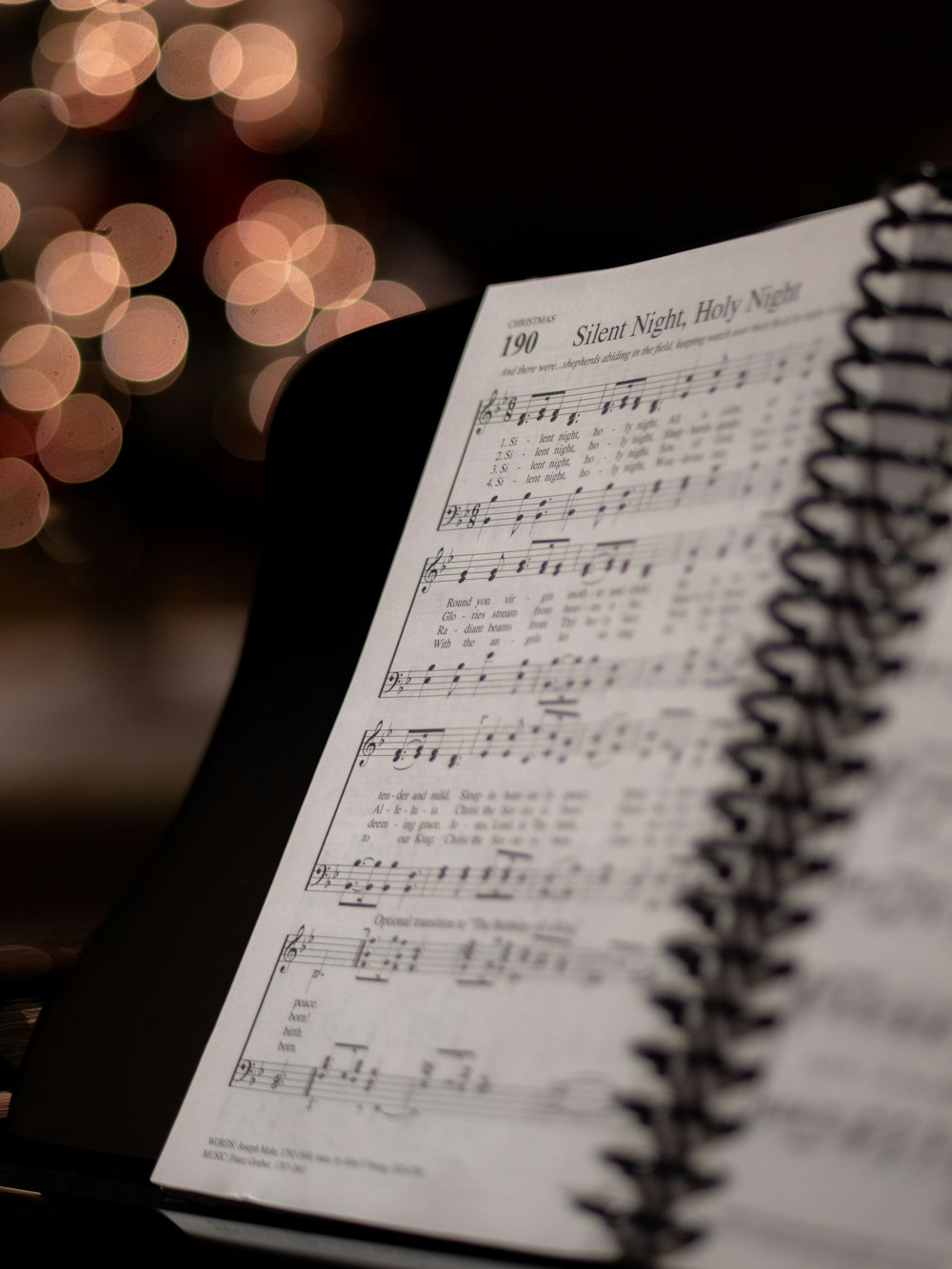
    opened musical book at Silent Night, Holy Night page

    The first Christmas carol came from France. The singers would dance as they sang – the word ‘carol’ means a circling dance.

    It’s not easy to identify the very first carol ever written, but there are a few contenders. Whilst Christmas music has been written since the 4th century, it was used in church services until around the 13th century. In fact, music wasn’t even used in church services until the 12th century!

    The oldest Christmas songs we know about are religious. The Latin song which celebrates Jesus, ‘Jesus Refulsit Omnium‘ – which means ‘Jesus Illuminates All’ – was composed by St. Hilary of Poitiers in the 4th century. This was probably after the very first Christmas celebration in 336 AD!

    There is a French version of a song about the animals which were present at the birth of Christ. It is called ‘The Friendly Beasts’ and was written in the 12th century. Many believe this to be the earliest Christmas carol, and is still sung today!

    It was not until the 16th century that a carol was written which is very famous and, again, is sung today: ‘God Rest Ye Merry, Gentlemen.’ This is a very famous carol and many churches sing it regularly at Christmas services.

    One thing we do know, however, is that Christmas carols have been sung in UK churches for around 800 years. Some of our most popular carols are very old, but every year new ones are written.

    Click here to listen to some traditional Christmas Carols.

  • Christmas: Santa Claus

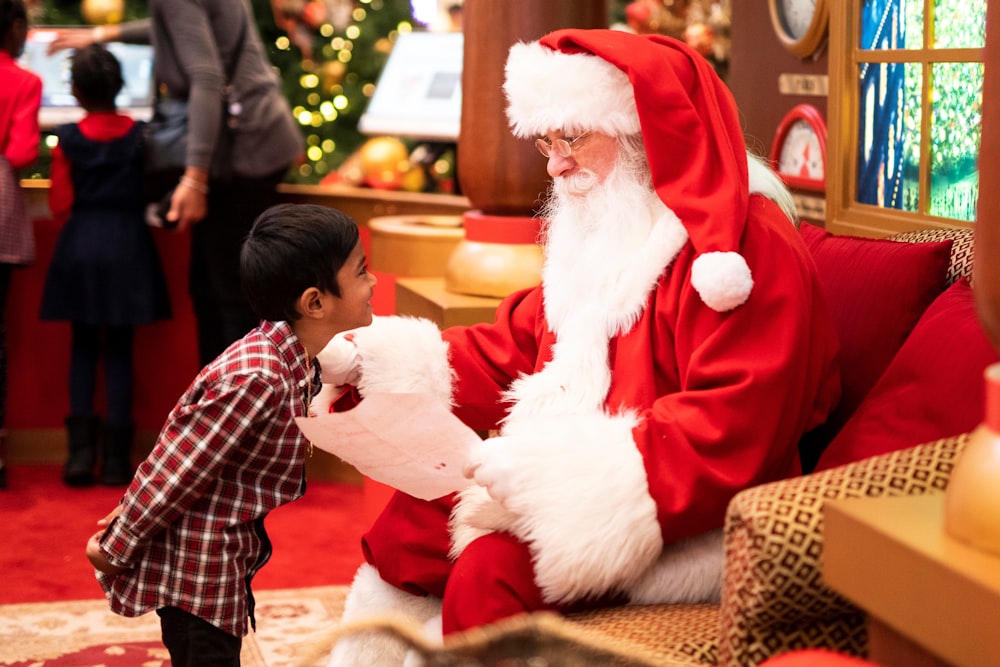
    boy standing in front of man wearing Santa Claus costume

    The name ‘Santa Claus’ comes from Saint Nicholas who was Bishop of Myra, which is now in Turkey. There are no historical documents about him, so everything we know comes from old traditional stories. Here are some of the things people think they know about Saint Nicholas:

    • He was born in the ancient Lycian seaport of Patar.
    • He travelled to Palestine and Egypt, and then became Bishop of Myra.
    • He was imprisoned during the Roman Emperor Diocletian’s persecution of Christians.
    • He was released under the rule of the Christian Emperor Constantine.
    • He died in Myra on 6th December 345 or 352, where his shrine became famous.
    • His body was moved to Bari in Italy in 1087, where the new shrine became a popular place of pilgrimage.

    Nicholas was remembered for his kindness and generosity and many legends came to be told about him. Saint Nicholas’ Day is celebrated each year on 6th December. On this day Dutch children will put out a wooden clog and in the morning they find it full of special chocolate and sweet treats. In Britain, he is celebrated on Christmas Eve, December 24th, when he is remembered as bringing gifts to children.

More posts